 (855) 369-9993


















Duncan Family Law Divorce Lawyers Beverly Hills
November 4, 2026
Most family court hearings in Los Angeles are short. A typical Request for Order hearing on custody, support or a restraining order lasts 20 to 40 minutes. The judge has usually read your papers before you walk in.
You will probably wait longer than you talk. Plan on spending most of a morning or an afternoon at court, even if your case only takes a few minutes in front of the judge.
This guide walks through what happens on the day, step by step, and how to prepare in the week before. It also covers the Los Angeles details most guides skip: custody mediation through Family Court Services, appearing remotely, and posted tentative rulings.
What kind of hearing do you have?
Check the notice or the first page of your court papers. The name of the hearing tells you how long it will take and whether the judge will make orders that day.
| Hearing | What it’s for | Typical length | Orders made? |
|---|---|---|---|
| Request for Order (RFO) | Temporary custody, visitation, child or spousal support, attorney fees, use of the home | 20 to 40 minutes | Yes, usually temporary orders |
| Domestic violence restraining order (DVRO) hearing | Deciding whether a temporary restraining order becomes a longer order | 15 minutes to a few hours | Yes, an order can last up to 5 years |
| Status or case management conference | Checking where the case stands and setting next dates | 5 to 15 minutes | Usually only scheduling orders |
| Settlement conference | Trying to settle open issues with a judge or settlement officer | Half a day or more | Only if you both agree |
| Evidentiary hearing or trial | Deciding contested issues with witnesses and exhibits | An hour to several days | Yes, often final orders |
| Default or prove-up hearing | Finishing a case where the other side never responded | 10 to 20 minutes | Yes |
If you’re not sure which one you have, call the clerk of the department listed on your notice, or ask at your courthouse’s self-help center. Most of this guide focuses on the Request for Order hearing, since it is the one most people face first.
What happens at a family court hearing, step by step
Every department runs a little differently, but most Los Angeles family law hearings follow the same order.
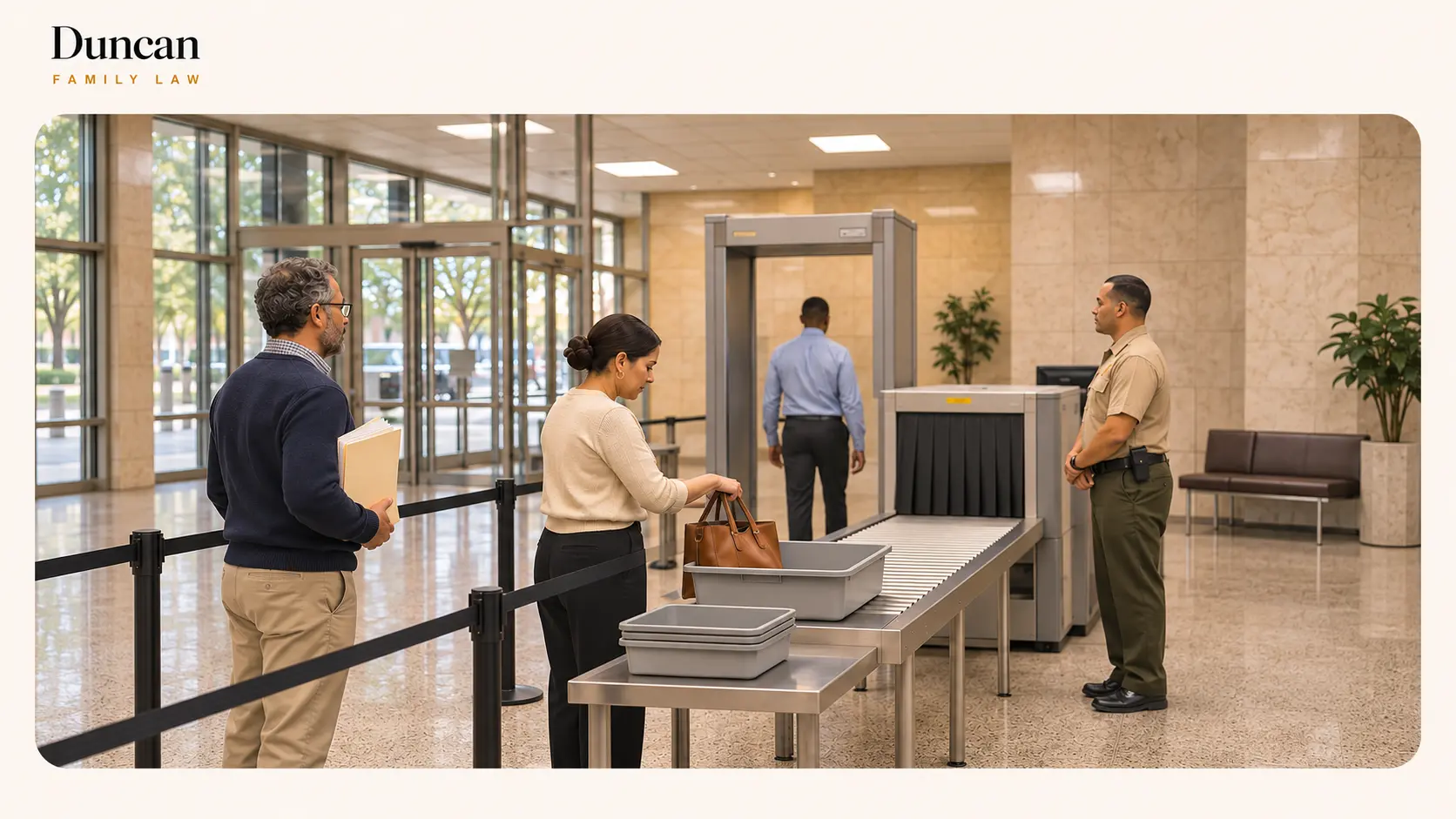
- Arrive early and go through security. Courthouse security works like an airport line. Leave pocket knives, scissors and anything sharp at home. Give yourself at least 30 to 45 minutes before your hearing time.

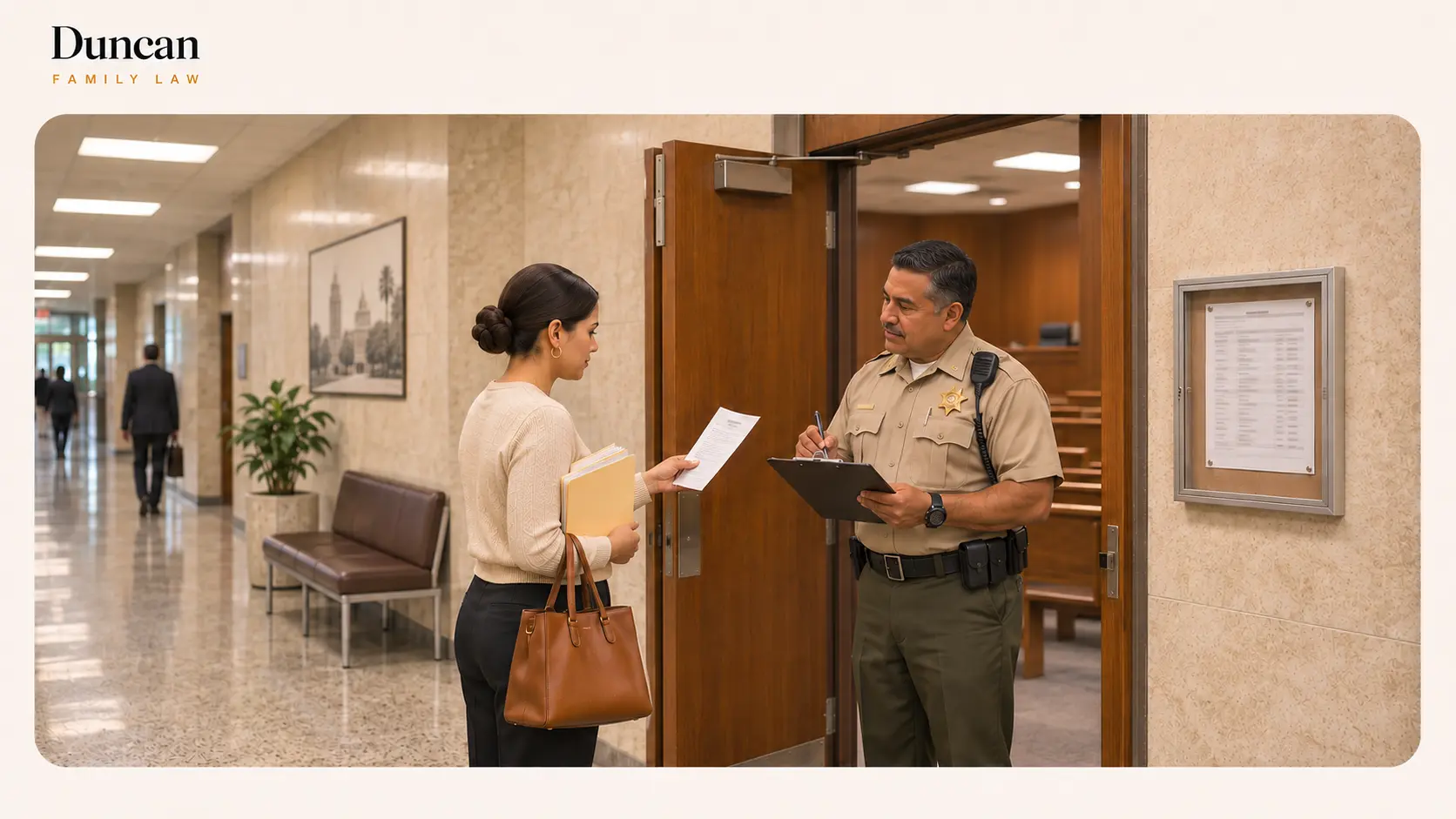
- Find your department and check in. Your notice lists a department number, such as “Dept. 2”. Check in with the clerk or bailiff when you arrive, so they know you’re there.
- Wait for your case to be called. Many cases are set for the same time slot, so you may wait a few minutes or more than an hour. Use the time to reread your notes. Don’t talk about your case in the hallway, because the other side, or their lawyer, may be standing nearby.

- Step up when your name is called. The clerk or bailiff will show you where to stand or sit. You and the other party face the judge, not each other.
- State your name and take the oath. The judge asks each side to state their name for the record. You may be sworn in to tell the truth.
- The person who filed speaks first. If you filed the Request for Order, you usually go first. Then the other side responds. Both of you get a turn.
- The judge asks questions. This is the main part of most hearings. The judge has already read your Request for Order and the other side’s Responsive Declaration, so expect focused questions rather than a chance to retell everything.
- The judge decides. Most judges rule the same day. Sometimes the judge sets another date, orders custody mediation or a 730 custody evaluation, or takes the matter “under submission” and rules later in writing.
- The order is written up. In some departments court staff prepare the order. In others, one side must prepare a Findings and Order After Hearing (form FL-340). Once it is signed, both sides must follow it.
What the judge is likely to ask
The California Courts Self-Help Guide lists the kinds of questions judges commonly ask:
- What would you add to what you already filed?
- Why doesn’t the other side’s proposal work for your child or your family?
- Can you explain something you wrote in your declaration?
That is why your written papers matter so much. A hearing is usually not your first chance to tell your story. It is the judge checking the story you already filed.
Check for a tentative ruling first
Some Los Angeles family law departments post tentative rulings online before the hearing. A tentative ruling is the judge’s likely decision, based on the papers. You can look for one on the court’s Family Law Division page.
If your department posts one, read it before you go. It shows you which points the judge cares about. Follow the posted instructions for telling the court whether you will appear to argue it.
How to prepare for a family court hearing
Most of your hearing is decided before you walk in. The judge reads the papers first, so the work you do in the weeks before matters more than anything you say on the day.
Weeks before: get your papers right
- Keep your declaration short and specific. California Rule of Court 5.111 limits a declaration supporting or responding to a Request for Order to 10 pages, and a reply declaration to 5 pages. Dates, quotes from messages and clear examples beat long stories.
- File and serve on time. If the other side filed the Request for Order, you need to file a Responsive Declaration (FL-320) by the deadline, even if you plan to attend the hearing.
- Attach only evidence tied to what you’re asking for. The judge can only decide the issues in the papers. A text about the custody schedule helps your case. Complaints about the marriage usually don’t.
- Bring a proposal, not just a complaint. If the hearing is about custody, have a specific parenting schedule ready, including weekdays, weekends and holidays. If it is about support, have your Income and Expense Declaration (FL-150) filed and current.
If your hearing is about custody, read how Los Angeles judges weigh child custody under the best-interests standard. Small habits count too. Our article on the “fun parent” custody mistake covers patterns judges notice.
The week before
- Read the other side’s papers twice and note every point you disagree with.
- Write a one-page outline: what you are asking for, your 3 strongest facts, and your answer to their 3 strongest points.
- Practice saying it out loud to a friend, in under 5 minutes.
- Check the department’s tentative rulings page and the court’s remote appearance options.
- If you need an interpreter, request one in advance. Los Angeles Superior Court provides interpreters for family law hearings, and the request forms are on the Family Law Division page.
- Arrange childcare. Don’t bring your children to the hearing unless the court has told you to.
What to bring: a day-of checklist

- ☐ Your hearing notice with the department number and time
- ☐ Photo ID
- ☐ 3 copies of everything you filed: one for you, one for the judge, one for the other side
- ☐ Copies of any evidence you plan to mention, with copies for the other side
- ☐ Your one-page outline
- ☐ A pen and notepad
- ☐ Your current Income and Expense Declaration, if support is at issue
- ☐ A proposed parenting schedule, if custody is at issue
- ☐ Water and a snack, since you may wait a while
What to wear
Dress the way you would for a job interview: clean, simple and conservative. Business casual is fine. Avoid clothing with slogans, sunglasses and hats.
You don’t need a suit. You need to look like someone who takes the day seriously.
How to talk to the judge
- Call the judge “Your Honor.” Speak to the judge, not to your ex.
- Answer the question you were asked. Then stop. If you don’t know, say “I don’t know.”
- Don’t interrupt. You’ll get your turn, even if the other side says something untrue. Write it down and answer it when the judge turns to you.
- Use facts, not labels. “He returned our daughter 2 hours late on March 3, 10 and 17” persuades. “He’s a terrible father” does not.
- It’s okay to be nervous. If you lose your place, you can say, “Your Honor, may I take a moment to check my notes?” The self-help guide specifically says you can ask for this.
A quick example. The judge asks why you oppose a 50/50 schedule.
- Weaker answer: “Because she’s never been responsible, and the kids don’t want to go.”
- Stronger answer: “Our son’s school is 40 minutes from her apartment. In the last 2 months he was late 6 times on her days. I’m asking to keep the school-week schedule as is and add a weekday dinner for her.”
The second answer gives the judge facts and a workable alternative. That is what judges are looking for.
Custody hearings: mediation with Family Court Services comes first
If you and the other parent disagree about custody or visitation, California requires you to try mediation before a judge decides. In Los Angeles County, that happens through Family Court Services (FCS).
What to know before your appointment:
- Complete the orientation. LA Superior Court asks parents to finish the free online “Our Children First” orientation, available in English and Spanish, before mediation.
- Know which kind of session you have. According to LA Family Court Services, your case may go to confidential mediation, to Child Custody Recommending Counseling (CCRC), or to both.
- Confidential mediation: what you say stays private.
- CCRC: the counselor can write a report with a recommendation that the judge, both parents and the lawyers will see.
- Ask FCS which one you have, because it changes how you prepare.
- Focus on the children. Come with at least 2 workable schedule options, including school breaks and holidays. Talk about your child’s needs, not your ex’s faults.
- Raise safety concerns directly. If there has been domestic violence, tell FCS before or at the start of the appointment. You may be able to meet separately. A finding of domestic violence also affects custody under Family Code 3044.
If you reach an agreement in mediation, it can go to the judge for approval. If you don’t, the judge decides at the hearing.
Can you appear remotely?
Often, yes. Los Angeles Superior Court offers remote video and audio appearances in family law departments through LACourtConnect. You sign up through the court’s Family Law Division page before the hearing.
Before you choose remote:
- Check the fee and the rules. Look up the current fee and any fee waiver options on the LACourtConnect site, and confirm your department allows it for your type of hearing. Evidentiary hearings with witnesses often need in-person attendance.
- Test your connection and log in early. Join from a quiet, private room. Don’t drive while you’re on the call.
- Send your evidence ahead of time. You may not be able to share your screen, so file and serve any exhibits in advance.
- Dress and act the same as you would in person. The judge can see you.
What happens after the hearing?
- Get the written order. Ask the clerk whether the court will prepare it or whether you need to prepare a Findings and Order After Hearing (FL-340). It must match exactly what the judge said.
- Follow it right away. A temporary custody or support order applies from the date the judge makes it, not from when it is mailed.
- Support from a paycheck needs a separate order. If support was ordered, you may need an Earnings Assignment Order served on the paying parent’s employer.
- Temporary orders matter more than people expect. They often become the baseline for the final judgment. Our guide to California’s six-month divorce waiting period explains why the first months of a case carry so much weight.
- If you disagree with the ruling, you usually can’t just file the same request again. Talk to a lawyer about whether a request to change the order, or another step, makes sense.
Do you need a lawyer for a family court hearing?
Not always. Many people handle a simple Request for Order on their own with help from the court’s free Self-Help Centers and the Family Law Facilitator. Both are listed on the LA Family Law Division page.
A lawyer is usually worth it when:
- The hearing is an evidentiary hearing or trial, with witnesses and cross-examination.
- Custody is high-conflict, or the other parent has a lawyer.
- There are domestic violence allegations on either side. See our domestic violence restraining order page.
- Support depends on complicated income, such as a business, bonuses, RSUs or self-employment. See child support and spousal support.
- The temporary orders will likely shape the rest of a Los Angeles divorce.
Talk to a Los Angeles family law attorney
A family court hearing is short, but the orders that come out of it can shape your family for years. If your hearing involves children, a business, complicated income or safety concerns, Duncan Family Law can help you prepare your papers and your presentation.
Call (855) 369-9993 or schedule a confidential consultation.
This article is general information, not legal advice. Court procedures change, and each department has its own practices. Check your notice and the court’s website, and talk to a California family law attorney about your situation.