Contact Us Now
Let's Talk

Postnuptial Agreement Lawyer in Los Angeles, California

Marriage changes. A business gets started, an inheritance arrives, equity compensation vests, or a couple simply wants to update their financial arrangement to reflect the life they are actually living rather than the one they had at the wedding.

Los Angeles marriages absorb these shifts constantly: Westside real estate that appreciates by seven figures in a decade, entertainment industry income that arrives in irregular bursts years after the work is finished, and closely held businesses that grow from an idea into a company worth fighting over.

A prenup is negotiated between two people still free to walk away. A postnup is signed by two people who already owe each other a fiduciary duty — which is exactly why disclosure and independent counsel decide whether it survives.

A postnuptial agreement gives married couples a legally enforceable way to define how those changes are treated, on their own terms, before a divorce filing forces the conversation. California holds these agreements to a demanding standard because spouses already owe each other a fiduciary duty once they are married, which makes the drafting process fundamentally different from a prenuptial agreement negotiated before the wedding.

Duncan Family Law represents clients throughout Los Angeles County who need a postnuptial agreement drafted, reviewed, or defended by an attorney who understands that standard in detail.

Considering a postnuptial agreement in Los Angeles?

Call Duncan Family Law at (855) 369-9993 for a confidential consultation.

SCHEDULE A CONSULTATION

Key Takeaways

—  Postnups are harder to enforce than prenups. Because spouses already owe each other fiduciary duties, courts scrutinize a postnuptial agreement more closely than one signed before the wedding.

—  Two statutes do the heavy lifting. California requires careful compliance with Family Code §721 (the interspousal fiduciary duty) and §852 (the express-declaration rule for transmutations).

—  Full financial disclosure is essential. Even an unintentional omission can give a court grounds to void the agreement — courts have set postnups aside on exactly this basis.

—  Independent legal counsel is strongly recommended. It is required for a spousal-support provision to hold and is the strongest evidence the agreement was entered knowingly.

—  Business owners use postnups to address changes after marriage. When a company is started or grows during the marriage, a postnup can define ownership, future appreciation, and a buyout formula.

—  Coordinate the agreement with the estate plan. Wills, trusts, and beneficiary designations should tell the same story as the postnuptial agreement, or the inconsistency creates the very ambiguity it was meant to remove.

—  A well-drafted agreement reduces future litigation. Defining the rules while the marriage is intact avoids a contested characterization and valuation fight later.

The Attorney

Los Angeles Postnuptial Agreement Attorney Nicole Duncan, Esq.

Duncan Family Law is a boutique family law firm founded and led by Nicole Duncan, Esq., a California family law attorney whose practice is concentrated in divorce, marital agreements, and complex property division throughout Los Angeles County.

She regularly appears before the Los Angeles County Superior Court, including the Stanley Mosk Courthouse and other family law divisions, and advises clients based on how postnuptial agreements are actually treated when tested in these courts, not how they are supposed to work in theory.

Nicole holds a Juris Doctor from Whittier Law School and a Bachelor of Business Administration from the USC Marshall School of Business, where she completed the Lloyd Greif Center for Entrepreneurial Studies.  She also holds a Certificate in International Law from King’s College London, relevant where a couple holds assets or business interests outside the United States.

In postnuptial matters involving a closely held business, entertainment income, or a significant real estate portfolio, direct attorney involvement from start to finish is how an agreement is built to survive a later challenge.

SCHEDULE A CONSULTATION

Attorney Credentials

Attorney Credentials

  • California State Bar No. 328341, Active, admitted 2019
  • D., Whittier Law School
  • B.A., USC Marshall School of Business — Lloyd Greif Center for Entrepreneurial Studies
  • Certificate in International Law, King’s College London
  • Licensed: California and Colorado
  • Member: State Bar of California, American Bar Association, Los Angeles County Bar Association, Beverly Hills Bar Association, Consumer Attorneys Association of Los Angeles

Call (855) 369-9993

Los Angeles Office: 8075 W 3rd St

Beverly Hills Office: 468 N Camden Dr

The Basics

What Is a Postnuptial Agreement Under California Law?

A postnuptial agreement is a written contract between two people who are already married. Like a prenuptial agreement, it addresses how property, income, and financial obligations will be treated if the marriage ends. Unlike a prenuptial agreement, it is signed after the wedding, while the parties are already bound by the legal duties that marriage creates.

The Legal Foundation for Postnuptial Agreements

California has no single statute called the postnuptial agreement act. Enforceability is built from three sources working together: Family Code §1500, which authorizes spouses to alter their statutory property rights by written agreement; the transmutation rules at §§850–853; and the interspousal fiduciary duty at §721. A postnuptial agreement that reclassifies property must satisfy all three, not just the general contract requirements that apply to agreements between strangers.

The Fiduciary Duty That Sets Postnups Apart

Family Code §721(b) requires spouses to deal with each other with the highest good faith, including full access to financial records and true, complete information about anything affecting community property. Because that duty exists, California courts apply a presumption of undue influence whenever a postnuptial agreement benefits one spouse at the other’s expense. The spouse seeking to enforce the agreement, not the spouse challenging it, carries the burden of proving it was fair.

The California Supreme Court’s decision in In re Marriage of Dawley confirmed that postnuptial agreements can be valid when they are fair, transparent, and voluntary. Courts have also set aside postnuptial agreements in which one spouse concealed financial information from the other, underscoring that the disclosure process matters as much as the final document itself.

SCHEDULE A CONSULTATION

Common Reasons Los Angeles Couples Pursue Postnuptial Agreements

  • One spouse starts or acquires a business, production company, or professional practice after the wedding
  • A significant inheritance or trust distribution arrives, and the couple wants to confirm its character as separate property
  • Equity compensation, entertainment industry income, or investment portfolios have grown substantially and the couple wants defined rules for how those assets are treated
  • The couple is working through a period of marital difficulty and wants a financial framework as part of repairing the relationship
  • A spouse is taking on a new professional role with different income expectations, and the couple wants to update their financial arrangements accordingly
  • Estate planning goals have evolved and the postnuptial agreement needs to coordinate with trusts, wills, and beneficiary designations
  • A couple relocated to California from a state with different marital property rules and wants their financial arrangement to be clearly enforceable here

A well-drafted postnuptial agreement does not signal distrust. It reflects a clear-eyed, mutual understanding of how the couple’s finances are structured and what each person can expect going forward.

If a change in your financial circumstances has raised questions about how your marriage’s assets are structured, call Duncan Family Law at (855) 369-9993 for a confidential consultation.

Enforceability

California’s Enforceability Requirements for Postnuptial Agreements

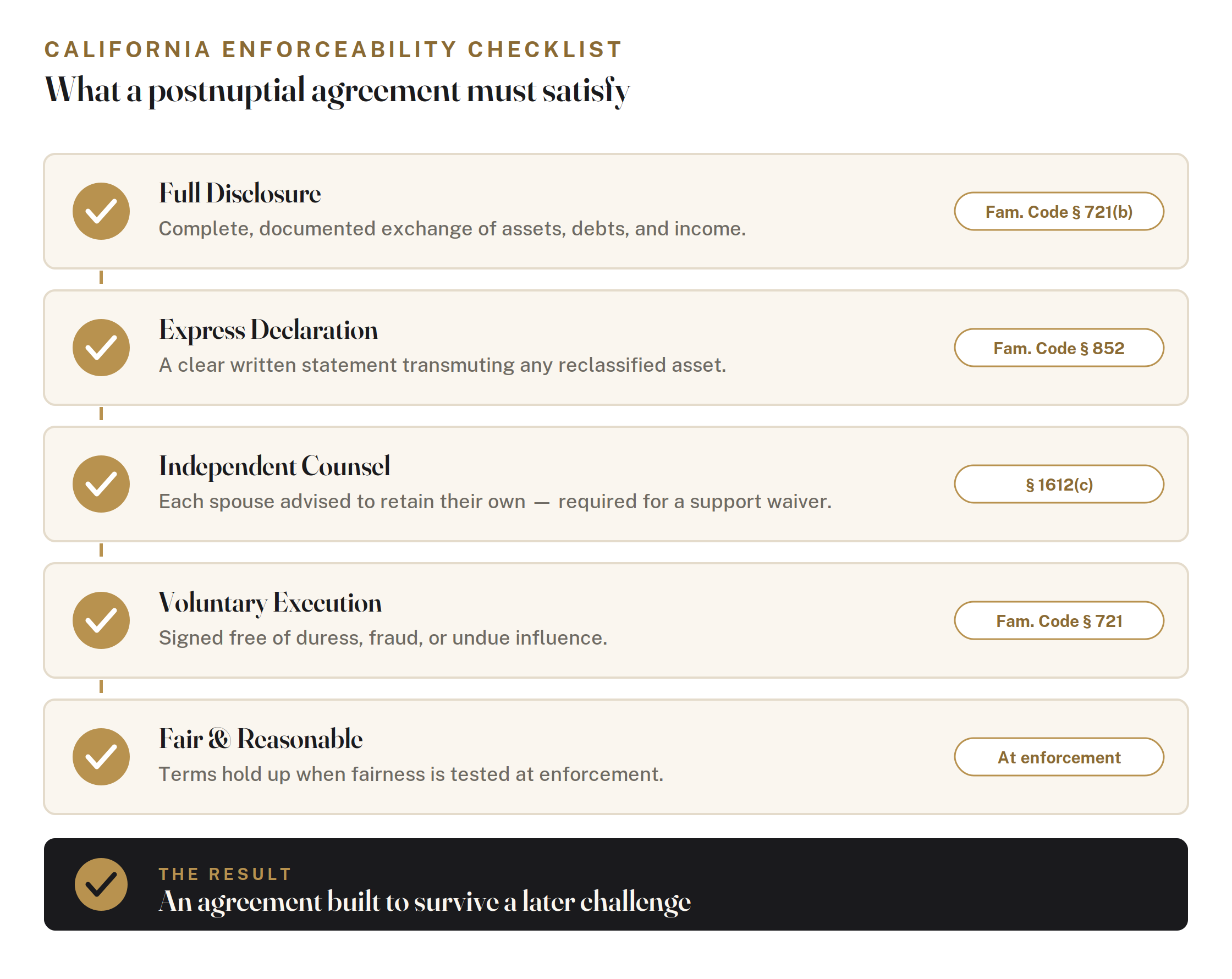
California courts apply a demanding standard to postnuptial agreements. Falling short of any one of these requirements can render an agreement unenforceable at the exact moment it matters most — together, they form the checklist a court works through when the agreement is challenged.

SCHEDULE A CONSULTATION


California enforceability checklist - postnuptial

Miss any one and the agreement is exposed; satisfy all five and it is built to hold.

Express Written Declaration for Any Property Reclassification

Under Family Code §852, a transmutation — meaning any change in the character of property from community to separate or separate to community — is not valid unless made in writing by an express declaration that the spouse whose interest is affected actually accepted. General or vague language is not enough. The agreement must state clearly that the character or ownership of specific property is changing.

Full Financial Disclosure

Both spouses must fully disclose assets, debts, income, and liabilities before signing. Family Code §721(b) requires each spouse to render true and full information about anything affecting community property on request. Even an unintentional omission can give a court grounds to void the agreement later, which is why we build a documented disclosure schedule into every engagement rather than relying on an informal exchange of information.

Independent Legal Counsel

California does not require independent counsel for every provision, but courts view its absence with real skepticism given the presumption of undue influence. Any provision addressing spousal support is subject to the independent-counsel standard, as Family Code §1612(c) applies to premarital agreements and is extended by analogy to postnuptial agreements.

Proceeding without separate counsel on a support provision carries a significant risk of enforceability, and even outside the support context, an unrepresented spouse who later challenges the agreement has an easier argument that they did not understand what they signed.

Voluntary Execution

The agreement must be free from duress, fraud, or undue influence. Because spouses already owe each other a fiduciary duty, courts examine the timing and circumstances of signing more closely than they would for a prenuptial agreement negotiated between two people who were still free to walk away. An agreement presented alongside an ultimatum, or timed to coincide with a major financial event such as a funding round or a business sale, invites exactly this kind of scrutiny.

Fair and Reasonable Terms at the Time of Enforcement

Unlike most prenuptial agreement provisions, which are generally tested for fairness as of the date they were signed, postnuptial agreements can be reviewed for fairness at the time enforcement is actually sought. Terms that looked balanced at signing may look very different years later, and that gap is exactly where postnuptial agreements are most often challenged.

SCHEDULE A CONSULTATION

Scope

What Can a Los Angeles Postnuptial Agreement Actually Cover?

A valid postnuptial agreement in California can address a wide range of financial questions, though it operates within real boundaries set by the Family Code and by public policy, including:

  • Designating specific assets, including a business or its future growth, as separate property
  • Rules for how future income, investments, or business earnings will be characterized
  • Spousal support rights and obligations in the event of divorce
  • What happens to a business, professional practice, or equity compensation if the marriage ends
  • Treatment of inherited assets and anticipated future inheritances
  • Coordination with wills, trusts, and other estate planning documents

There are clear limits. A postnuptial agreement cannot predetermine child custody or child support, and it cannot include terms that are illegal, unconscionable, or contrary to public policy.

An experienced Los Angeles postnuptial agreement attorney will help you understand where those lines fall and structure an agreement that works within them.

Business Owners

Postnuptial Agreements for Los Angeles Business Owners and Entrepreneurs

Los Angeles is dense with founders, physicians, entertainment executives, and professionals who build a company or practice after the wedding, not before it. A postnuptial agreement is often the only tool available once that opportunity has already arrived and a prenuptial agreement is no longer possible.

Protecting Business Growth During the Marriage

Absent an agreement, a business started during the marriage and the increase in value of a business owned before the marriage are generally treated as community property to the extent marital effort contributed to that growth. A postnuptial agreement can designate the business itself, a specific ownership percentage, or its future appreciation as separate property, provided the disclosure and transmutation requirements described above are met.

Example · A medical practice launched after the wedding

A couple marries, and a year later one spouse opens a medical practice. Five years on, the practice has grown substantially — and if the marriage ends, much of that growth is presumptively community property because it was built with marital effort. A postnuptial agreement can define, in advance, whether future appreciation remains community property, is partially reclassified as separate, or is subject to a predetermined buyout formula — replacing a contested valuation fight with a rule both spouses agreed to while the marriage was intact.

Buy-Sell and Buyout Provisions

Many business-owner postnuptial agreements go further than characterization and include a buyout formula: how the business will be valued if the marriage ends, who has the right to retain it, and over what period any equalizing payment will be made. Defining that formula while the marriage is intact avoids a contested valuation fight later, when the business itself may be at risk of disruption from litigation.

Coordination With Investors and Operating Agreements

Founders with outside investors, co-founders, or existing operating and shareholder agreements need a postnuptial agreement that does not conflict with those governing documents. We review buy-sell agreements, vesting schedules, and cap table structures alongside the marital agreement so the two documents work together rather than creating an ambiguity that surfaces during a later transaction or a divorce.

SCHEDULE A CONSULTATION

Industry Income

Postnuptial Agreements and Entertainment Industry Income

Los Angeles couples frequently include a spouse whose income comes from entertainment work: acting, writing, directing, producing, or representing those who do. That income raises characterization issues that a postnuptial agreement can resolve directly, well before any dispute arises.

Royalties and residuals as community property. Creative work produced during the marriage — a film score, a television writing credit, a recorded album — may continue to generate royalty and residual income for years after it was created. Under California community property law, the right to receive that income is itself a community asset, even when payments arrive long after the work is finished. A postnuptial agreement can define in advance how a spouse’s catalog, credits, or residual streams will be characterized and divided, rather than leaving that valuation to a contested divorce years later.

Intellectual property ownership. Beyond the income stream, the underlying intellectual property — the copyright, the master recording rights, the trademark — may itself be a divisible community asset if it was created or developed during the marriage. A postnuptial agreement can address both the economic value and the creative control questions, such as licensing authority, that a pure dollar allocation tends to ignore.

Backend participation and deferred compensation. Entertainment contracts frequently include backend participation rights — a percentage of net or gross profits — that may be contractually promised during the marriage but not yet paid. A postnuptial agreement can specify how these contingent future interests will be treated if the marriage ends, which removes a significant source of uncertainty from any later negotiation.

SCHEDULE A CONSULTATION

Property Division

Postnuptial Agreements and Property Division in Los Angeles

Los Angeles marriages frequently involve assets that benefit from explicit written treatment: Westside real estate, entertainment equity, closely held businesses, and concentrated investment positions.

California’s community property rules work for many couples, but not all. The line between community and separate property blurs when assets are commingled, when one spouse contributes labor to a separate property business, or when income from different sources flows into the same account.

A postnuptial agreement lets couples set their own rules for how specific assets are categorized and divided, provided the transmutation is documented the way §852 requires. See our property division practice for the complete legal framework.

Real Estate Down Payments and the Section 2640 Reimbursement Right

When separate property funds, such as premarital savings or an inheritance, go toward the down payment on a home titled as community property, Family Code §2640 already gives the contributing spouse a right to dollar-for-dollar reimbursement before the remaining equity is divided, absent a written waiver.

A postnuptial agreement can confirm that right, waive it, or replace it with different terms, which matters considerably in a Los Angeles real estate market where a down payment can represent a substantial share of a couple’s net worth.


Estate Planning

Postnuptial Agreements and Estate Planning Coordination

A postnuptial agreement rarely stands alone. Once a couple has defined how specific assets are characterized, that characterization needs to be reflected consistently across wills, revocable trusts, and beneficiary designations on retirement accounts and life insurance policies.

Inconsistencies between a postnuptial agreement and an outdated estate plan create exactly the kind of ambiguity these agreements are meant to eliminate. When appropriate, we coordinate directly with a client’s estate planning attorney, or refer clients to one, so that the postnuptial agreement and the broader estate plan tell the same story.

example · A $4 million inheritance received during the marriage

A spouse receives a $4 million inheritance after marriage and deposits it into an investment account. Inheritances are generally separate property under California law — but that character can erode once the funds are mixed with community money or used for community purposes. A postnuptial agreement can reinforce the inheritance’s separate-property status, set rules for any income or growth it generates, and coordinate that treatment with the family’s trust and estate plan, so a later dispute doesn’t turn on tracing years of account activity.

SCHEDULE A CONSULTATION

Pitfalls

Common Mistakes That Undermine a Postnuptial Agreement

Even couples who agree completely on the terms can end up with an unenforceable agreement if the process itself has gaps. The mistakes we see most often include:

  • Handling the agreement informally, without a signed writing that satisfies §852’s express-declaration requirement for any property being reclassified
  • Skipping a real financial disclosure schedule and relying on each spouse’s general understanding of what the other owns
  • Signing during an active marital crisis, which invites a later argument that the agreement was not truly voluntary
  • Using a downloaded template that does not reflect California’s fiduciary duty standard or the specific assets involved
  • Leaving one spouse unrepresented on a spousal support provision, which puts that provision at direct risk under §1612(c)
  • Failing to revisit the agreement as circumstances change, leaving terms that were fair at signing exposed to an unconscionability challenge years later.

If your Los Angeles postnuptial agreement involves a business, entertainment income, or significant real estate, call Duncan Family Law at (855) 369-9993 for a confidential consultation.


Step by Step

How to Create a Postnuptial Agreement in Los Angeles: The Process

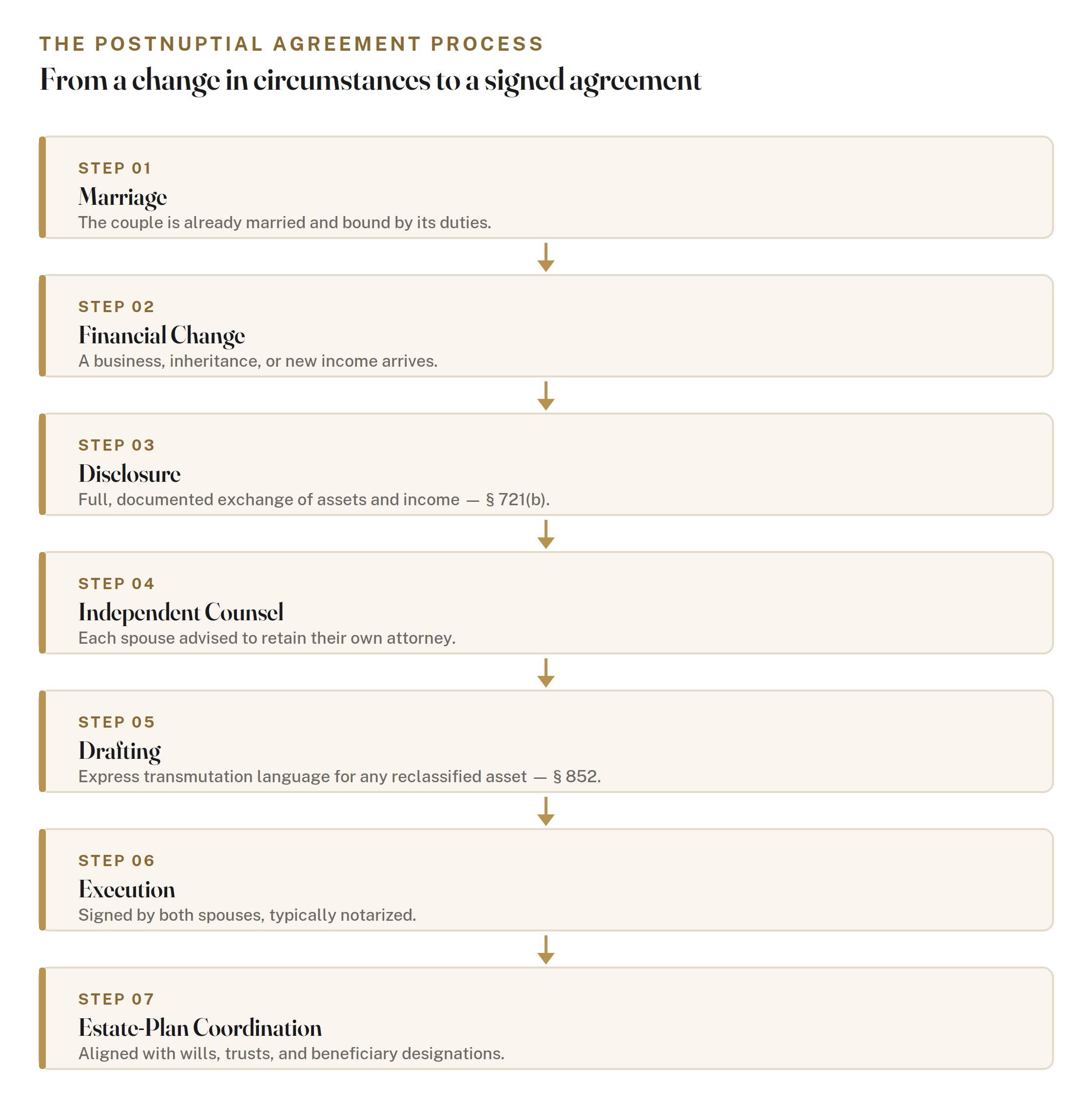
A postnuptial agreement is built in stages, and skipping a stage is usually what causes the agreement to fail later. At a high level, the path runs from the change in circumstances through coordination with your estate plan:

The agreement process

Disclosure and independent counsel sit early — they are what the enforceability standard turns on.

  1.   Initial Consultation and Goal-Setting. We start with a direct conversation about what each spouse is trying to accomplish, what assets and income are involved, and whether a postnuptial agreement is actually the right instrument.
  2.   Full Financial Disclosure. Both spouses assemble a complete, documented picture of assets, debts, income, and liabilities. This disclosure schedule becomes part of the agreement’s evidentiary record under Family Code §721(b).
  3.   Independent Counsel for the Other Spouse. When we represent one spouse, the other is advised in writing to retain independent counsel, particularly where the agreement addresses spousal support.
  4.   Drafting the Agreement. We draft precise transmutation language for any property being reclassified, satisfying the express declaration standard of §852, along with the substantive terms the couple has agreed to.
  5.   Review and Negotiation. Both sides and their respective counsel review the draft, raise questions, and negotiate any remaining terms before anyone signs.
  6.   Execution. The agreement is signed by both spouses, typically notarized, and any related transmutation of real property is documented for recording purposes.
  7.   Coordination With the Estate Plan. We confirm the agreement is consistent with existing wills, trusts, and beneficiary designations, and update those documents where necessary.
  8.   Periodic Review. Because postnuptial agreements can be reviewed for fairness at the time of enforcement, we recommend revisiting the agreement whenever circumstances change materially.
SCHEDULE A CONSULTATION

Prenup vs. Postnup

Postnuptial Agreements Compared to Prenuptial Agreements and Legal Separation

Couples who skipped a prenuptial agreement often assume that opportunity has passed. It has not.

Prenuptial agreements are governed by the Uniform Premarital Agreement Act at Family Code §§1600–1617, including a seven-day review period before signing under §1615. Postnuptial agreements are not subject to that seven-day rule, but the fiduciary standard under §721 applies in its place, and in practice it is the harder standard to satisfy.

Prenuptial vs Postnuptial

Same subject matter, higher bar: the fiduciary duty is what makes a postnup harder to enforce.

For a full walkthrough of the agreement signed before the wedding, see our prenuptial agreement page. And for couples considering legal separation rather than a full dissolution, a postnuptial agreement can address financial rights and obligations during the separation period.

SCHEDULE A CONSULTATION

Local Realities

Postnuptial Agreements in Los Angeles: What Sets These Cases Apart

Los Angeles County is not an average market for marital property planning. The concentration of business owners, entertainment professionals, and high earners here means that a couple’s financial picture can change dramatically within just a few years of marriage, often well before either spouse expected it.

Median single-family home prices across much of the Westside and Beverly Hills regularly exceed $2 million to $3 million, which means that a single real estate purchase, refinance, or improvement made with separate funds during the marriage can have outsized financial consequences if it is not clearly documented. Equity compensation, closely held businesses, and entertainment industry royalty streams are common enough in Los Angeles households that they show up in postnuptial agreements far more often than in most other parts of the country.

Duncan Family Law approaches every Los Angeles postnuptial agreement with those local realities as the starting point. Whether the agreement addresses a production company formed after the wedding, a Beverly Hills property purchased with a premarital down payment, or a technology equity grant that vested years into the marriage, the drafting process is built around the same rigorous disclosure and documentation standard.


The Difference

Why Los Angeles Couples Choose Duncan Family Law for Postnuptial Agreements

  • Exclusive family law focus: Duncan Family Law handles only divorce and family law, so its knowledge of California’s marital agreement and transmutation rules stays current and practically applied.
  • Financial depth for complex estates: We coordinate with forensic accountants when business valuation, equity compensation, and real estate financing questions come up in Los Angeles postnuptial work.
  • Enforceability as the design principle: Every agreement is built around the disclosure, transmutation, and independent-counsel standards that determine whether it survives a later challenge.
  • Coordination across professionals: We work directly with CPAs, business appraisers, and estate planning attorneys so the postnuptial agreement fits into the client’s complete financial picture.
  • Confidential, discreet process: Postnuptial agreements are private financial documents, and we handle them with the same discretion we bring to high-profile divorce matters.
SCHEDULE A CONSULTATION

Get Started

Speak With a Los Angeles Postnuptial Agreement Attorney

The most useful first step toward a postnuptial agreement is a direct, confidential conversation about your specific situation: your assets, your goals, and what a realistic agreement looks like under California law. Duncan Family Law is ready to provide that conversation — and the earlier it happens, the more room there is to build the disclosure record and drafting timeline that make an agreement hold.

Define the terms while the marriage is intact

Call Duncan Family Law at (855) 369-9993 to schedule your confidential consultation. Serving Los Angeles and Beverly Hills.

Duncan Family Law — Los Angeles Office

8075 W 3rd St, Los Angeles, CA 90048   ·   Phone: (855) 369-9993

Duncan Family Law — Beverly Hills Office

468 N Camden Dr, Beverly Hills, CA 90210   ·   Consultations by appointment only.

The Firm

About Attorney Nicole Duncan

Duncan Family Law is led by Nicole Duncan, a California family law attorney who founded the firm to provide focused, strategic representation in divorce and family law matters. Nicole represents clients throughout Los Angeles County from the firm’s Los Angeles and Beverly Hills offices. Learn more about the firm.

Credentials

  • California State Bar Number: 328341 (Active)
  • Colorado State Bar Number: 54630 (Active)
  • Juris Doctor (J.D.): Whittier Law School
  • B.A.: University of Southern California, Marshall School of Business (Lloyd Greif Center for Entrepreneurial Studies)
  • Certificate in International Law: King’s College London
  • Admitted to practice: 2019

Professional Associations

Nicole regularly appears before the Los Angeles County Superior Court, including at the Stanley Mosk Courthouse and in the surrounding family law divisions.

SCHEDULE A CONSULTATION

Sources of Authority

Statutes · California Family Code

  • 1500 (authority to alter property rights by agreement) · §§850–853 (transmutation; §852 express-declaration requirement) · §721 / §721(b) (interspousal fiduciary duty) · §1612(c) (independent-counsel standard, applied to support provisions by analogy) · §2640 (separate-property reimbursement) · §§1600–1617, §1615 (UPAA / prenuptial comparison).

Leading cases

In re Marriage of Dawley.

Frequently Asked Questions About Postnuptial Agreements in Los Angeles

Yes, if it meets California’s requirements for full financial disclosure, an express written declaration for any property reclassification, voluntary execution, and fair terms at the time of enforcement. Working with Nicole Duncan at Duncan Family Law from the start significantly improves an agreement’s odds of holding up.

California law does not technically require it for every provision, but courts closely examine whether both parties had the opportunity to consult separate counsel, and independent representation is required for a spousal support provision to be enforceable. Independent counsel on both sides is strongly advisable across the board.

Yes. It can specify whether support will be paid, in what amount, and for how long. Courts apply the independent-counsel standard that Family Code §1612(c) sets for premarital agreements to postnuptial support provisions as well, and any waiver must not be unconscionable at the time enforcement is sought.

A transmutation is a change in the character of property, from community to separate or separate to community. Family Code §852 requires an express written declaration that the affected spouse actually accepted. Postnuptial agreements that reclassify a business, an inheritance, or a piece of real estate must satisfy this requirement, or the reclassification will not hold up.

Yes, and this is one of the most common reasons Los Angeles couples pursue one. Absent an agreement, a business started during the marriage and its growth are generally community property. A properly disclosed and documented postnuptial agreement can designate the business, or its future growth, as separate property.

Royalties and residuals from creative work produced during the marriage are community property under California law, even if payments arrive years later. A postnuptial agreement can define in advance how a spouse’s catalog, credits, or backend participation rights will be characterized, which removes significant uncertainty from a later dispute.

Concealing assets or income breaches the fiduciary duty that Family Code §721 imposes on spouses. California courts have set aside postnuptial agreements on exactly this basis. Full disclosure protects both the agreement and the spouse relying on it.

Notarization is not strictly required by statute for the agreement itself, but it is common practice and strongly recommended for evidentiary purposes, particularly where the agreement reclassifies real property that will need to be recorded.

Prenuptial agreements are generally tested for fairness as of the date they were signed, under the Uniform Premarital Agreement Act. Postnuptial agreements can be reviewed for fairness at the time enforcement is sought, and courts presume undue influence whenever the agreement favors one spouse. That makes postnups the harder of the two to draft so that they survive years later.

Yes. Absent a written waiver, §2640 already entitles a spouse to reimbursement for separate property contributions toward the purchase of community property, such as a home down payment. A postnuptial agreement can confirm that default rule, waive it, or set different terms, which is worth addressing explicitly whenever real estate is involved.

Generally no, unless the agreement transfers or reclassifies a specific piece of real property, in which case a related deed or memorandum may need to be recorded to give the change effect against third parties. The underlying agreement itself is typically kept privately between the spouses and their attorneys.

You can attempt it, but the fiduciary duty and disclosure standards make self-drafted postnuptial agreements especially vulnerable to challenge. Given the presumption of undue influence that applies whenever a postnuptial agreement favors one spouse, having each side reviewed by independent counsel is the most reliable way to produce something that survives contact with a divorce court.

A postnuptial agreement addresses the character of property between spouses, not a spouse’s obligations to third-party creditors. Separate property can still be reached by that spouse’s individual creditors under applicable law, and an agreement designed primarily to defeat existing creditors can raise separate legal issues beyond family law. This is a conversation to have directly with your attorney based on your specific circumstances.

A useful starting set includes recent tax returns, statements for bank, brokerage, and retirement accounts, a summary of any business interests or equity compensation, mortgage and property records, and information about any inheritance or trust assets. Digital copies are sufficient for the initial consultation, and Duncan Family Law will tell you exactly what is needed once we understand your specific situation.

A straightforward agreement can often be completed within a few weeks. Agreements involving business valuations, entertainment income, or complex real estate take longer. Starting before any urgency arises is always preferable, and Duncan Family Law guides clients through the process efficiently at every stage.

Yes. Postnuptial agreements can be amended or revoked by written agreement of both spouses, provided the modification independently meets California’s disclosure and voluntariness requirements.

As early as possible, and ideally before the financial event you are trying to address — such as a business sale, a funding round, or a large inheritance — has already occurred. Early planning gives Duncan Family Law more room to build a disclosure record and a drafting timeline that protect the agreement.