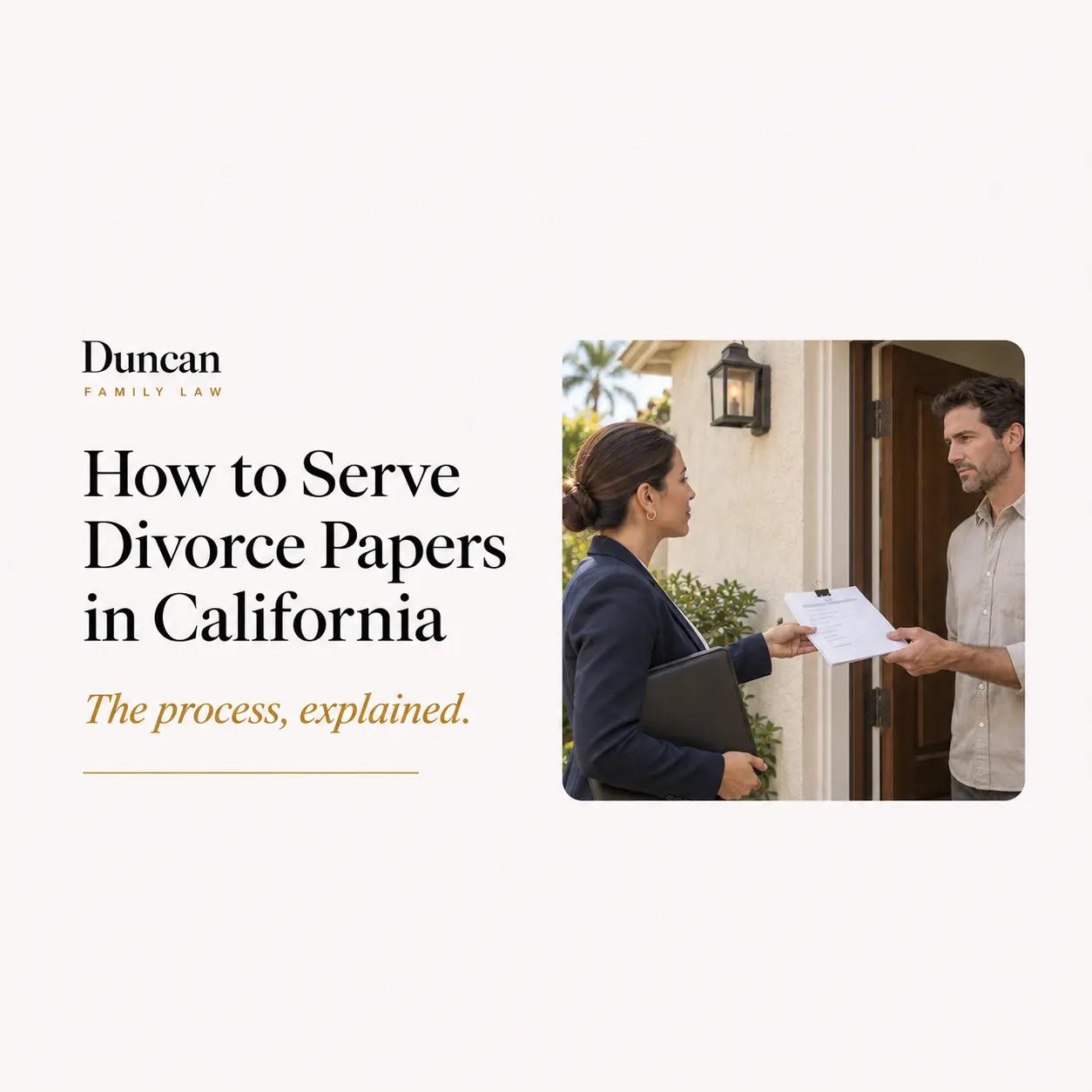
To serve divorce papers in California, someone who is 18 or older and not part of your case delivers copies of your filed papers to your spouse, then signs a Proof of Service of Summons (FL-115) that you file with the court. You can't serve the papers yourself. Once your spouse is served, they have 30 days to respond.
Service is the step that officially starts the divorce. Until it is done and the proof is filed, the court won't move your case forward, and the six-month waiting period doesn't begin.
This guide has two parts. Jump to the one that fits you:
This is general information, not legal advice for your case.
What to include when you serve divorce papers
File your papers first. You can serve them any time after the court stamps them. Your spouse must get a copy of everything you filed, plus blank forms they can use to respond.
The service packet:
- Copy of the filed Petition (FL-100)
- Copy of the filed Summons (FL-110), which includes the automatic temporary restraining orders on page 2
- Copy of the filed UCCJEA declaration (FL-105), if you have children together
- A blank Response (FL-120)
- A blank FL-105, if you have children together
- Any other papers you filed with the petition, such as a Request for Order (FL-300) with a blank Responsive Declaration (FL-320)
Keep your own stamped copy of each form. If you also filed a Request for Order with a hearing date, the packet must be served at least 16 court days before that hearing, plus 5 calendar days if served by mail.
If you have children together, the papers set up the first custody questions in the case. At Duncan Family Law, a Los Angeles child custody attorney can help when parenting plans or a possible move-away are part of what you are asking for.
Who can serve divorce papers in California?
Anyone who is at least 18 and not a party to the case can serve divorce papers in California. That means you can't do it, but you have three practical choices:
| Who serves |
Good for |
Trade-off |
| A friend or relative over 18 |
Cooperative spouses, low cost |
They must fill out the proof of service correctly |
| A registered process server |
Spouses who avoid service, workplaces, tight deadlines |
Usually costs more, but they know the rules and fill out FL-115 for you |
| The county sheriff |
Lower-cost option with an official server |
Can be slower; a fee applies unless you have a fee waiver |
If you are afraid of your spouse, don't send someone you know to their door. Use a process server or the sheriff, and if you need protection, ask about a restraining order. At Duncan Family Law, a domestic violence restraining order attorney in Los Angeles can help you ask for a temporary order before the full hearing.
Ways to serve divorce papers and when service is complete
The method you use decides the day service counts. That day starts your spouse's 30-day response clock and the six-month waiting period.
| Method |
How it works |
Service is complete |
| Personal service |
The server hands the papers to your spouse. If your spouse won't take them, the server can leave them nearby and say what they are |
The day the papers are handed over |
| Mail with Notice and Acknowledgment of Receipt (FL-117) |
The server mails the papers with FL-117 and a return envelope; your spouse signs and sends FL-117 back |
The day your spouse signs FL-117, not the day it was mailed |
| Substituted service |
After several real attempts at personal service, the server leaves the papers with a competent adult at home or work and then mails a copy |
10 days after the mailing |
| Spouse outside California |
Personal service there, or registered or certified mail with return receipt |
Personal: day of delivery. Mail: 10 days after mailing |
| Publication or posting (court order needed) |
When you truly can't find your spouse, the court can allow a newspaper notice or, in some cases, posting |
After the notice runs for the time the court orders |
Sources: California Courts Self-Help: serve your divorce papers, service by Notice and Acknowledgment of Receipt
If your spouse is cooperative, mail with FL-117 is usually the easiest and least stressful option. Signing FL-117 only confirms they received the papers. It does not mean they agree with anything. If they never sign and return it, you have to switch to personal service.
If your spouse refuses to be served, refusing doesn't stop service. A server can leave the papers near a spouse who won't take them. If your spouse keeps avoiding the server, substituted service is the next step.
If you can't find your spouse, you must show the court you searched carefully, such as checking last known addresses, relatives, employers and social media, before it allows publication or posting.
The day service is complete also starts California's waiting period. Here is how the six-month waiting period runs from the date your spouse is served, not from the day you filed.
Proof of service (FL-115) and the 2027 photo rule
After serving, your server fills out and signs the Proof of Service of Summons (FL-115) and gives it to you. You file it with the court. The court won't move forward until this form is filed.
The form asks how, when and where service happened, and who received the papers. For mail service, attach the signed FL-117. For substituted service, the server attaches a declaration describing the earlier attempts at personal service.
A change coming January 1, 2027. A new law, AB 747, adds requirements for personal and substituted service. The proof of service will need photos of the place where service happened or was attempted, taken close to the time of service, with an automatic date, time and GPS stamp. At least one photo must show the door of the home or the building entrance. For substituted service, the server must try personal delivery on at least 3 occasions, on 3 different days, at 3 different times. A photo can be skipped if taking one would put the server's safety at risk, but the server must explain why. Source: Judicial Council proposal SPR26-21
If a friend is serving for you after that date, make sure they know about the photo rule. If you hire a process server, ask how they handle the new photo requirement.
What to do when you've been served with divorce papers
Being served doesn't mean anything has been decided. It means your spouse has started a case, and you now have 30 days to file a Response if you want a say in what happens. Here is a first-week checklist:
- Write down the date you were served. If you signed FL-117, count from the day you signed it. Your 30 days start then.
- Read every page, especially the Summons. Page 2 lists automatic temporary restraining orders that now apply to you, such as not taking the children out of California without consent or a court order, and not cashing out, hiding or giving away property.
- Don't ignore it. If you don't file a Response within 30 days, your spouse can ask for a default, and the court can end the marriage, divide property and debts, and make custody and support orders without hearing from you.
- Decide whether to respond. Filing a Response (FL-120) lets you tell the court what you want. If you have children together, also file FL-105. A Response has a filing fee, or you can ask for a fee waiver.
- Have someone serve your Response on your spouse, by mail or in person, and file the proof of service.
- Start your financial disclosures. You will need to share a Declaration of Disclosure, a schedule of assets and debts, and an Income and Expense Declaration. Start gathering pay stubs and statements now.
- Get help if the stakes are high. If there are children, a house, a business or a lot of conflict, talk to a lawyer before you file anything.
Sources: Self-Help: learn your options after being served, SF Superior Court: how to respond to a divorce
Missed the 30 days? If your spouse hasn't asked the court for a default yet, you may still be able to file a Response. Check with the court clerk right away.
Want to settle instead of fight? Filing a Response doesn't commit you to a court battle. Many couples use it to protect their rights and then work out an agreement. At Duncan Family Law, divorce mediation in Los Angeles is led by Nicole Duncan as a neutral mediator, for couples who want to settle property, support and custody outside the courtroom.
Common mistakes to avoid
If you are serving:
- Serving the papers yourself. Service by a party doesn't count, even if your spouse accepts the papers from you.
- Leaving out a form. A missing blank Response or FL-105 can lead to arguments later about whether service was complete.
- Counting from the wrong day. For FL-117, the clock starts on the date your spouse signed, not the mailing date.
- Not filing FL-115. The case sits still until the proof of service is filed.
- Jumping to publication too early. Courts want to see a real search first.
If you were served:
- Thinking refusing the papers stops the case. It doesn't.
- Waiting until day 29. Preparing a Response, especially with children or property, takes time.
- Moving money or the children. The automatic restraining orders on the Summons already apply to you.
- Assuming signing FL-117 means you agree. It only confirms you received the papers.
FAQ
Can you serve divorce papers by mail in California? Yes, if your spouse cooperates. An adult who isn't part of the case mails the papers with a Notice and Acknowledgment of Receipt (FL-117). Service is complete when your spouse signs it. If they don't sign, you need personal service.
Can I serve my spouse myself? No. The server must be 18 or older and not a party to the case. A friend, relative, process server or sheriff can do it.
What happens if my spouse refuses to be served? Service still counts if the server leaves the papers near your spouse and tells them what they are. If your spouse avoids the server altogether, you can use substituted service after several real attempts.
How do I serve divorce papers if I don't know where my spouse is? Search carefully first, then ask the court for permission to serve by publication or, in some cases, posting.
How long does my spouse have to respond? 30 days from the date service is complete. After that, you can ask for a default if they haven't responded.
Does being served mean I have to go to court? Not right away. It means you have 30 days to file a Response. A court date only comes up if one of you asks for a hearing, such as for temporary custody or support.
Can divorce papers be served by email or text? Generally not for the first papers in a divorce. The petition and summons are served by one of the methods above, unless a judge specifically orders another method in an unusual case.
When service gets complicated
Most couples can handle service with a friend or a process server. It gets harder when a spouse is avoiding service, lives in another state or country, or when you were served and the papers ask for custody, support or property orders that would affect you for years.
Duncan Family Law handles divorce cases in Los Angeles and Beverly Hills from the first filing and service onward. You can request a confidential consultation, or read how a Los Angeles divorce attorney at the firm takes a case from the petition and service through to judgment.
 (855) 369-9993